
OBS Studio Setup
This page sets up OBS Studio to stream normal video, called SDR (standard dynamic range), from a capture device to Pixelview. If nobody has told you the project is HDR, this is your guide. For HDR, see OBS Studio for HDR.
Prefer a simpler setup?
On a Mac or Windows PC with a Blackmagic capture device, Pixelview Desktop streams to Pixelview without URLs, stream keys, or encoder settings. OBS Studio stays fully supported if you would rather keep one app.
You need OBS Studio (latest version), an active Pixelview project, and a capture card such as a Blackmagic DeckLink 4K Mini connected by SDI to your suite's output.
1. Set up Pixelview Admin
- In Pixelview Admin, select the encoder, open Settings and set Input Color Profile to Rec.709 (Color Settings).
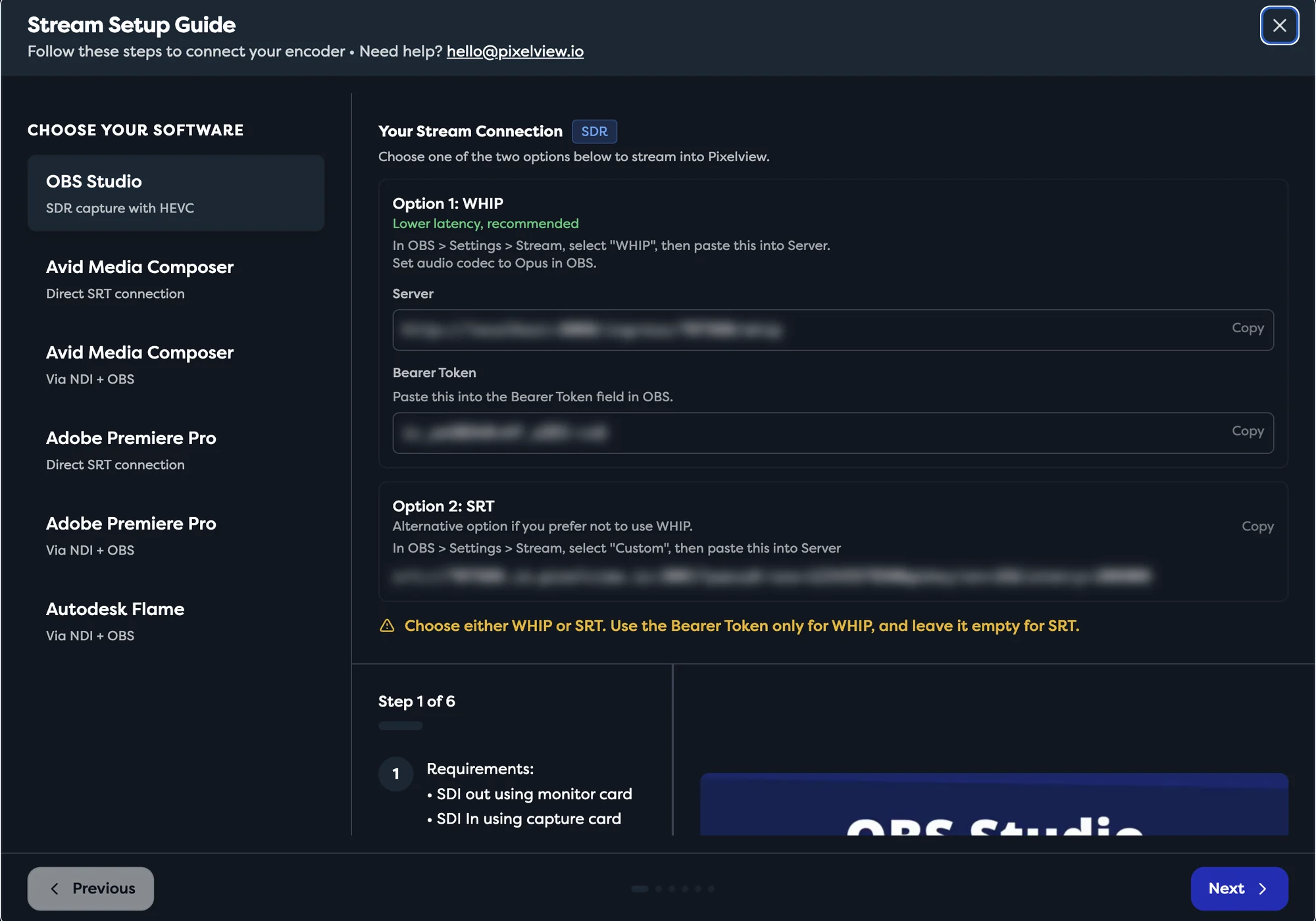
- On the project page, click Setup Instructions, choose OBS Studio, and use Option 1: WHIP. Keep the page open; you need its Server and Bearer Token in step 4.
2. Download OBS
Download OBS Studio from obsproject.com.
3. Add the capture card
Click + under Sources, select Blackmagic Device (or your capture card type), choose the device, and click OK.
4. Connect to Pixelview
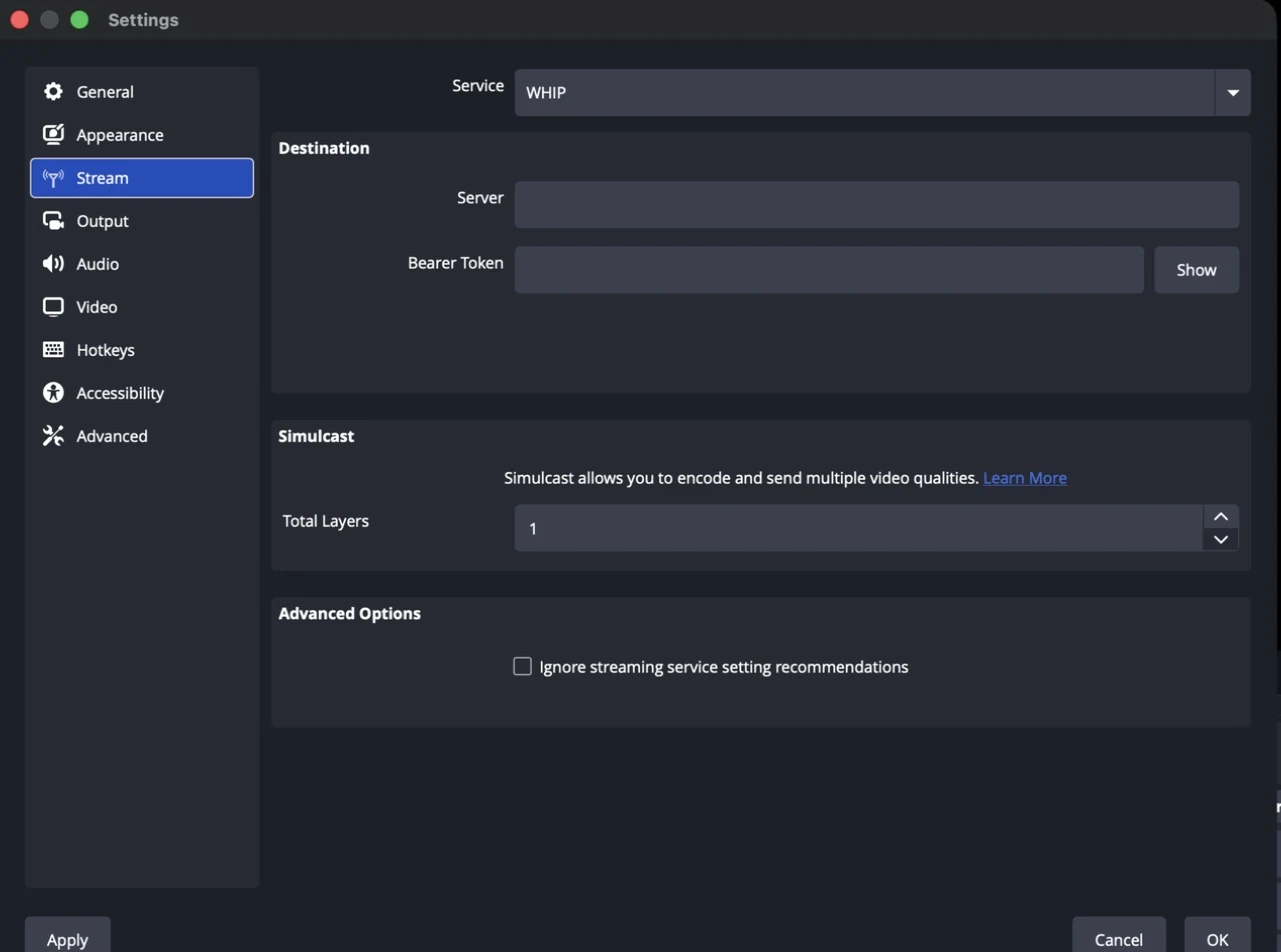
Open Settings → Stream and set:
| Setting | Value |
|---|---|
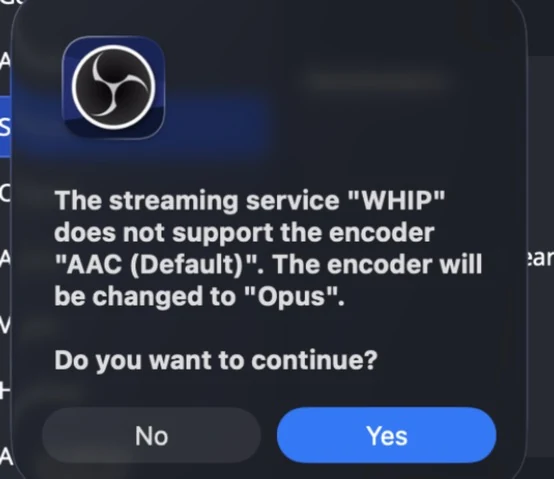
| Service | WHIP. OBS then asks to change the audio encoder to Opus; click Yes. |
| Server | Server from Pixelview Setup Instructions |
| Bearer Token | Bearer Token from Pixelview Setup Instructions |
WHIP gives lower delay than SRT from OBS. If OBS does not list WHIP, update OBS Studio. Only if you still cannot use WHIP, select Custom, paste the SRT server URL from Setup Instructions into Server, and leave Stream Key empty.
5. Configure output settings
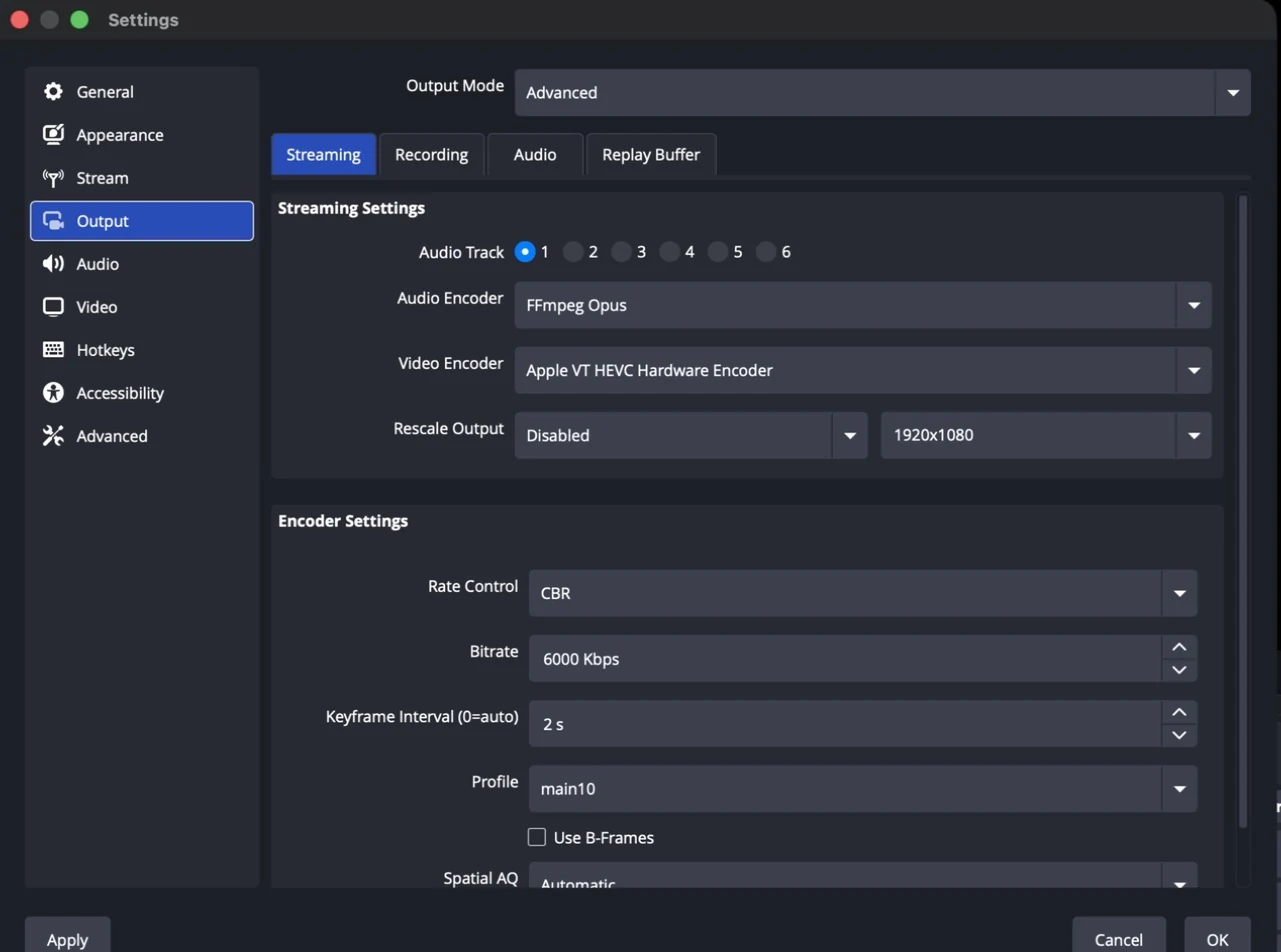
Open Settings → Output and set Output Mode to Advanced:
| Setting | Value |
|---|---|
| Video Encoder | A hardware HEVC encoder, for example Apple VT HEVC Hardware Encoder on a Mac or NVIDIA NVENC HEVC on Windows |
| Audio Encoder | FFmpeg Opus, not AAC |
| Rate Control / Bitrate | CBR, 5000 to 12000 Kbps |
| Keyframe Interval | 2 s |
| Profile | main10 (recommended). Use main 4:2:2 10 only if you need 4:2:2 and your encoder supports it. |
| Use B-Frames | Off, where the encoder shows this option |
Older computers without a hardware HEVC encoder may only offer x264. In that case, use Encoder x264, Video Bitrate 5000 Kbps, CPU Usage Preset ultrafast, Profile baseline, Tune zerolatency, and Audio Codec Opus.
6. Configure color settings
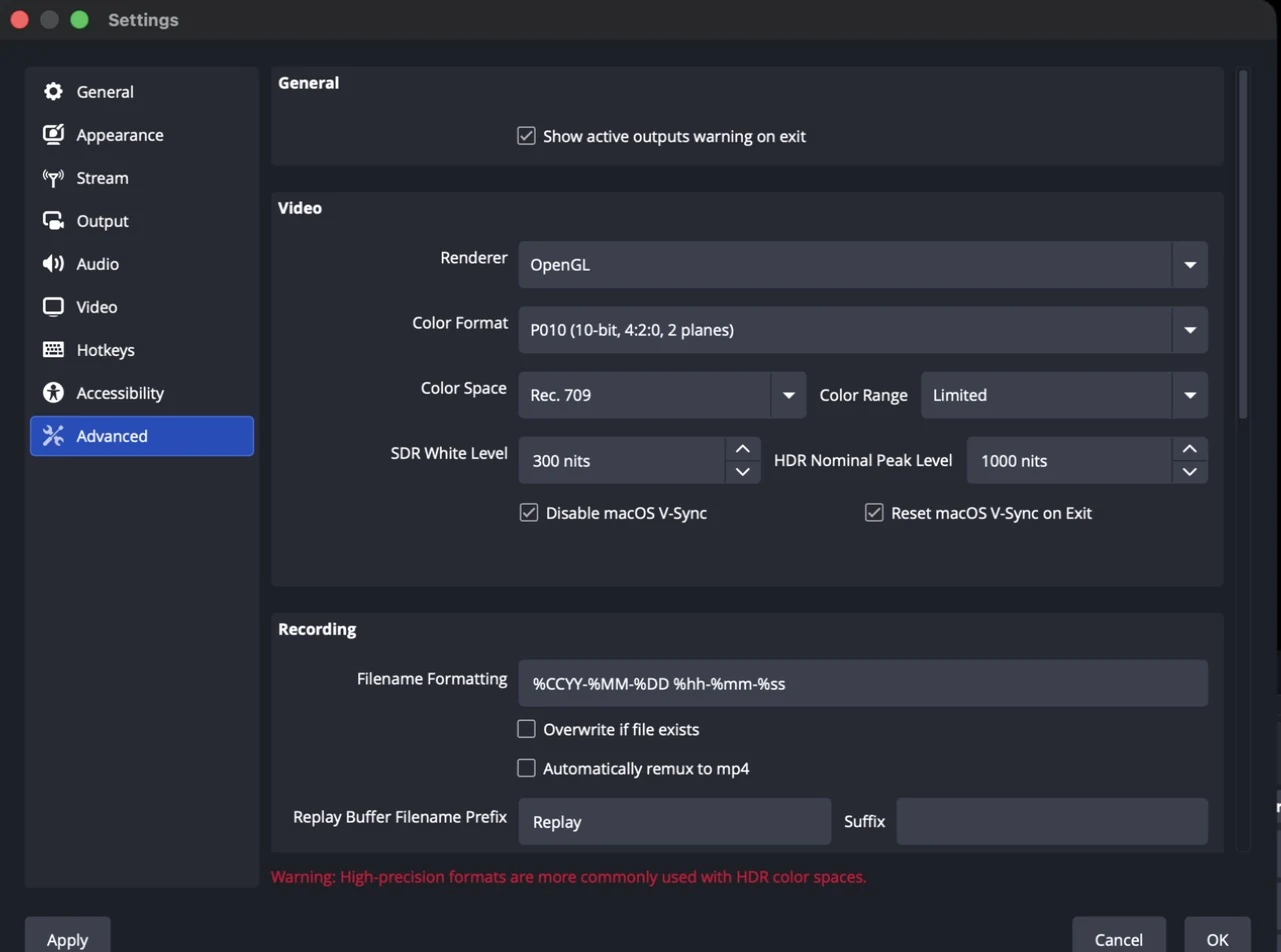
Open Settings → Advanced:
| Setting | Value |
|---|---|
| Color Format | P010 (10-bit, 4:2:0, 2 planes), to match main10. Use P216 (16-bit, 4:2:2, 2 planes) only with main 4:2:2 10. |
| Color Space | Rec. 709 |
| Color Range | Limited |
OBS shows a red note that high-precision formats are more common with HDR. For 10-bit SDR this is expected and you can ignore it.
7. Start streaming
Click Start Streaming. Confirm the stream is active in Pixelview Admin, then open the viewer link in Chrome, Edge, or the Pixelview Player app. Safari is more limited with 10-bit video. See Watch in a Web Browser and iPhone and iPad Apps.
Troubleshooting
| Problem | Fix |
|---|---|
| WHIP is missing | Update OBS Studio and restart it. Use SRT only if WHIP is still unavailable. |
| OBS cannot connect | Confirm the project is active, re-copy the current Server and Bearer Token, and check the audio codec is Opus. Stop and start streaming. If the session seems stuck, restart the server from Admin. |
| Poor playback | Choose a Pixelview region close to you and your viewers, use WHIP rather than SRT, check viewer stats in Admin, try Chrome, Edge, or the Pixelview Player app, and lower the bitrate if the viewer's network is limited. |