
OBS Studio for HDR
This page sets up OBS Studio to stream HDR (beta) to Pixelview. It follows the same steps as the SDR guide, with HDR settings for your source, capture card, OBS, and Admin.
Pixelview Desktop is recommended for HDR
With a Blackmagic capture device, use Pixelview Desktop. It sends HDR automatically when the encoder's Input Color Profile is set to an HDR profile. Use this OBS guide if you have a capture device from another manufacturer.
You need an HDR-capable SDI output and capture card (for example a Blackmagic DeckLink 4K Mini), and a viewer device that supports HDR. The Pixelview hardware encoder (Magewell) does not support HDR; use OBS or Pixelview Desktop with a supported capture card on the same account.
1. Set up Pixelview Admin
- In Pixelview Admin, select the encoder and open Settings.
- Set Input Color Profile to match your source, and set Max Luminance (HDR) for the session. See Color Settings.
- On the project page, open Setup Instructions, choose OBS Studio, and use Option 1: WHIP to get the Server and Bearer Token.
| Input Color Profile | Where it plays in HDR |
|---|---|
| Rec.2020 PQ / ST2084 | iPhone and iPad apps, Chrome and Edge where available |
| Rec.2020 HLG | iPhone and iPad apps where available |
| P3-D65 PQ/ST2084 — sending with OBS | iPhone and iPad apps, Chrome and Edge where available |
Not on Apple TV
HDR is not available on Apple TV. An HDR session plays there in SDR, tone-mapped.
2. Download OBS
Download OBS Studio from obsproject.com.
3. Set DaVinci Resolve HDR output

In Resolve's monitoring output settings, with colour management set up for HDR:
- Uncheck 444 SDI. OBS does not support it.
- Enable 10 bit output.
- Use the Rec.2020 color matrix, also for P3D65.
- Enable HDR metadata.
4. Add the capture card
Click + under Sources, select Blackmagic Device (or your capture card type), and choose the device. Then set:
| Setting | Value |
|---|---|
| Color Space | Rec.2020 (also for P3D65) |
| Color Range | Match your source/Resolve settings |
| Allow 10-bit | Enabled |
5. Connect to Pixelview
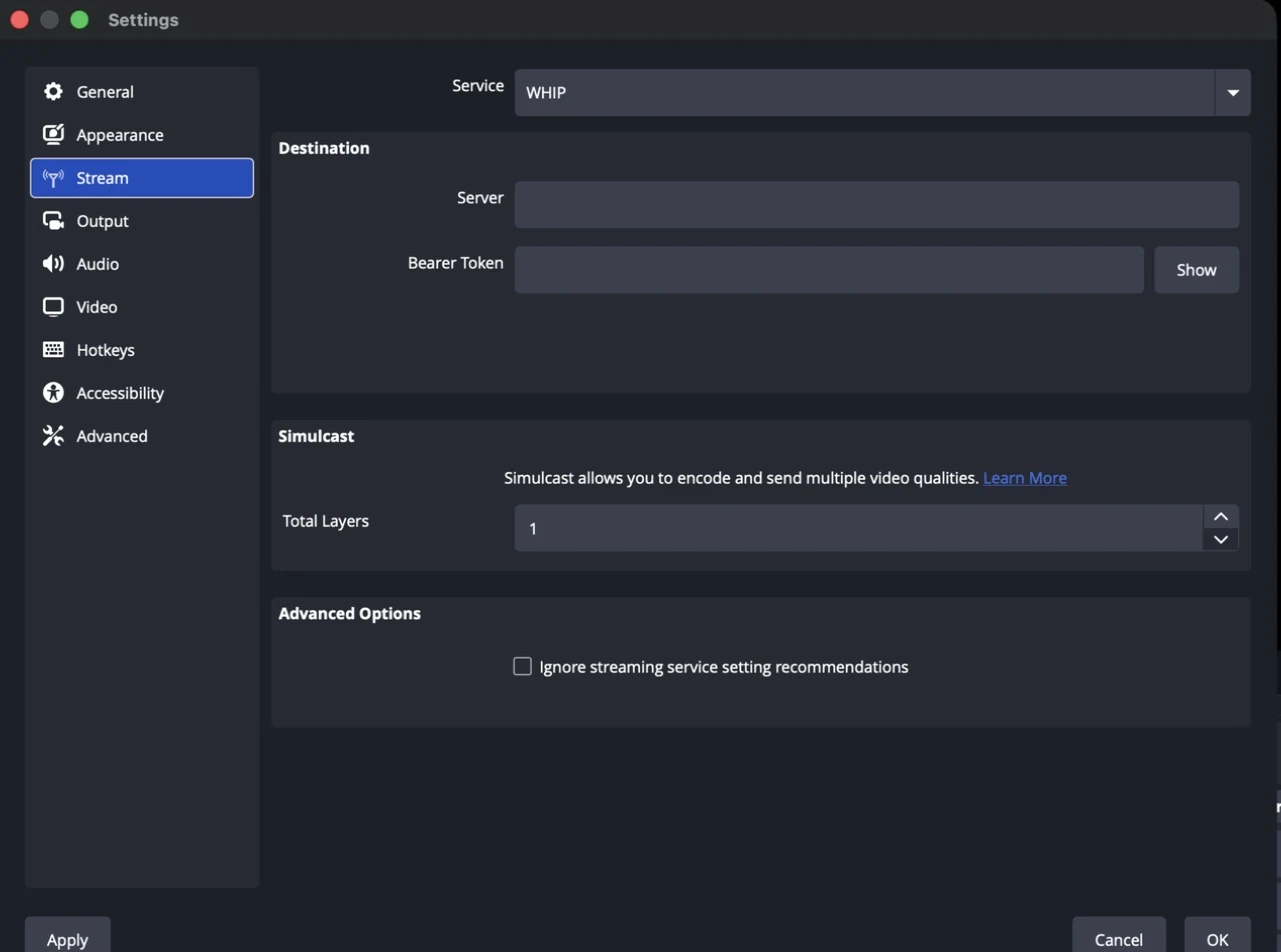
Open Settings → Stream, select WHIP, and paste the Server and Bearer Token from Setup Instructions into the fields of the same names. If WHIP is missing, update OBS Studio; use the SRT fallback only if that fails.
6. Set encoder settings
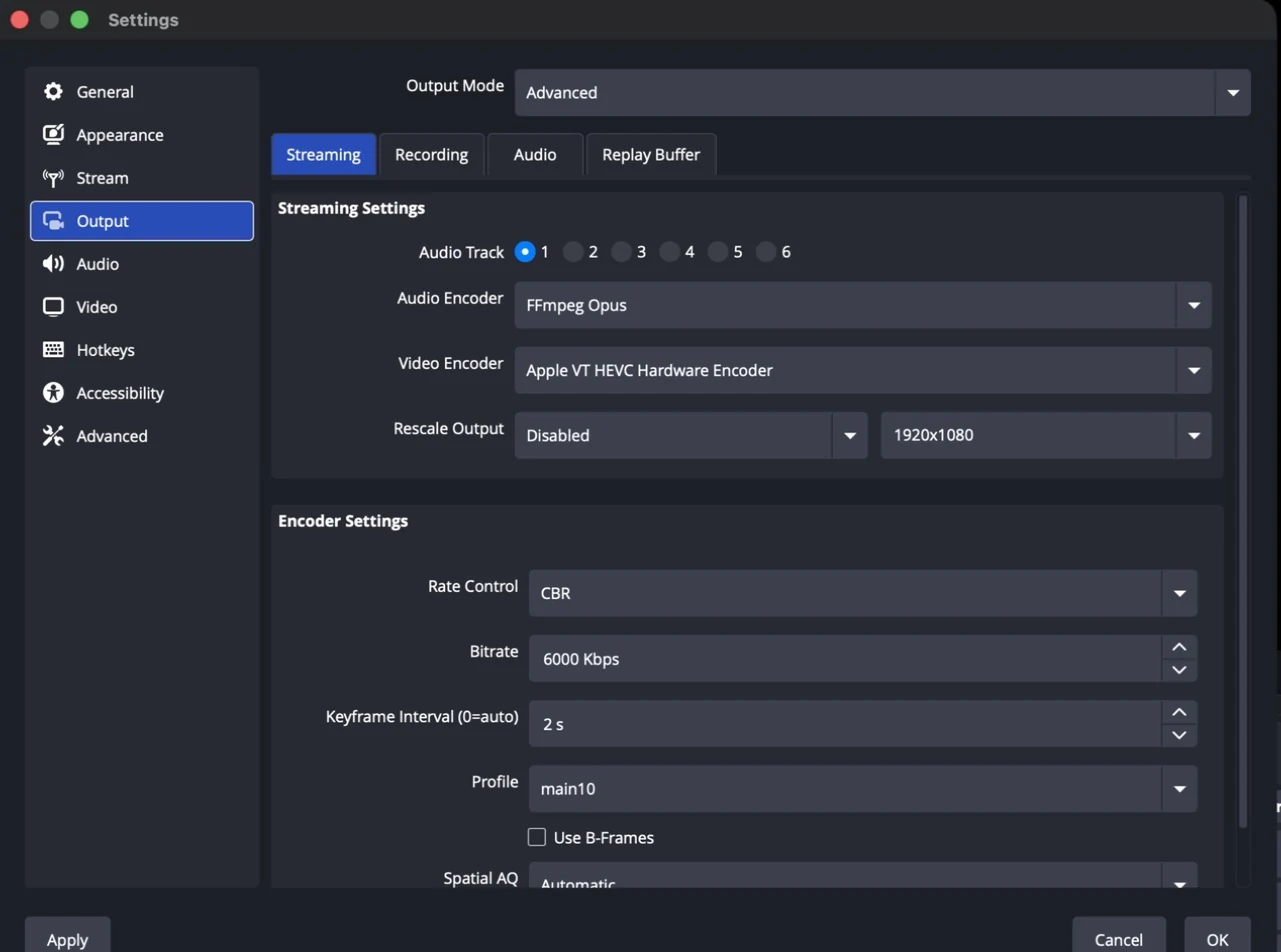
Open Settings → Output and set Output Mode to Advanced:
| Setting | Value |
|---|---|
| Video Encoder | A hardware HEVC encoder, for example Apple VT HEVC Hardware Encoder |
| Audio Encoder | FFmpeg Opus, not AAC |
| Rate Control / Bitrate | CBR, 5000 to 12000 Kbps |
| Keyframe Interval | 2 s |
| Profile | main10 (recommended). Use main 4:2:2 10 only if you need 4:2:2 and your encoder supports it. |
| Use B-Frames | Off, where the encoder shows this option |
7. Set HDR color settings
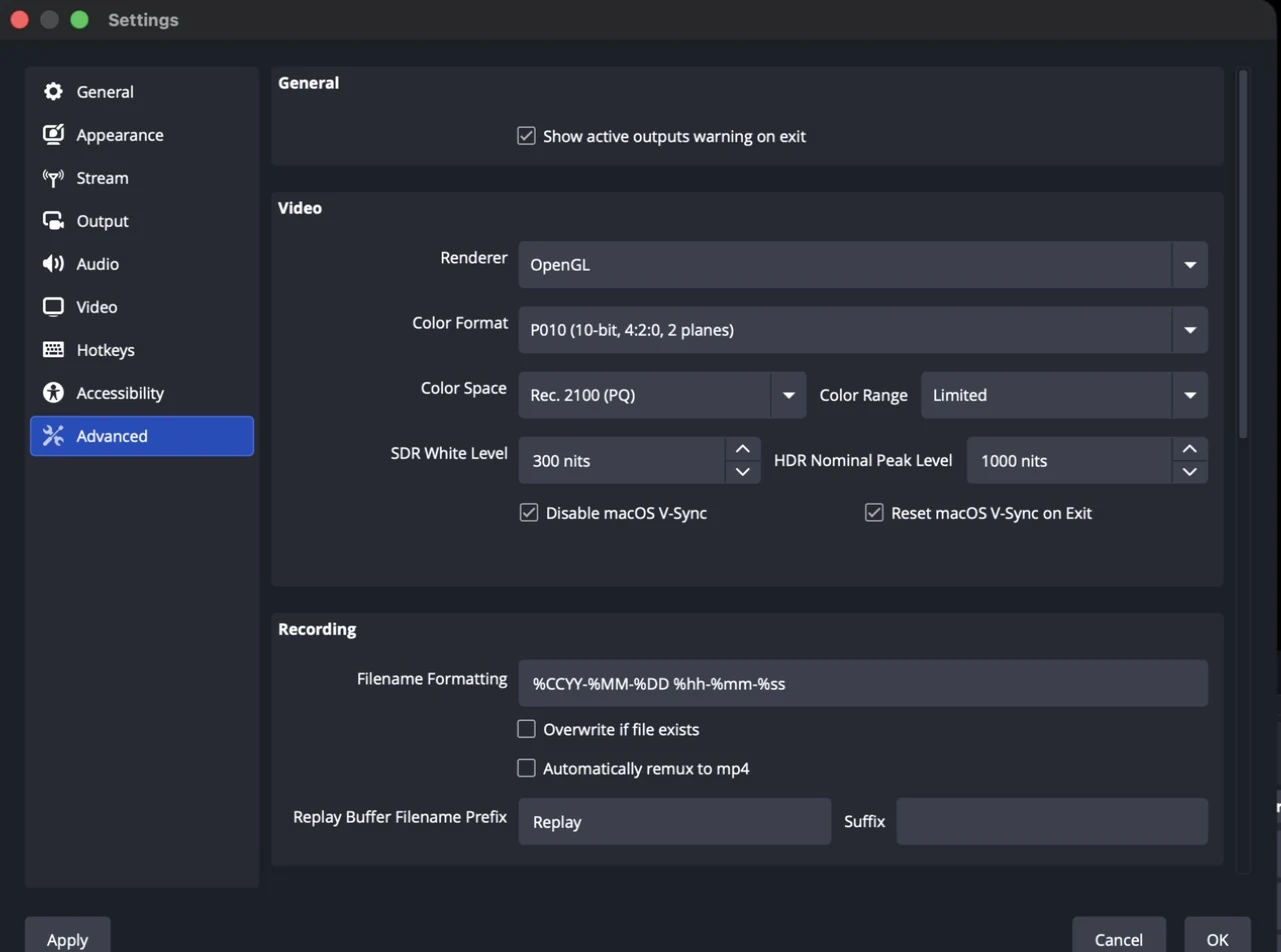
Open Settings → Advanced:
| Setting | Value |
|---|---|
| Color Format | P010 (10-bit, 4:2:0, 2 planes), to match main10. Use P216 (16-bit, 4:2:2, 2 planes) only with main 4:2:2 10. |
| Color Space | Rec. 2100 (PQ) for PQ, including P3-D65, or Rec. 2100 (HLG) for HLG |
| Color Range | Limited, unless your full workflow has been tested otherwise |
| HDR Nominal Peak Level | Match the max luminance set in Admin, for example 1000 nits |
8. Start streaming
Click Start Streaming. Confirm the stream is active in Pixelview Admin, then test the viewer link on the target device: Chrome or Edge on an HDR-capable system, or Pixelview Player on a supported iPhone or iPad (with Reference Mode on iPad Pro when appropriate).
Troubleshooting
HDR does not look right. Check, in order: the source's HDR output and metadata, the capture card settings in OBS, the OBS Output and Advanced color settings, and the Admin Input Color Profile and Max Luminance. Test in Chrome or Edge and on a supported iPhone or iPad. If the full HDR chain cannot be verified, fall back to Rec.709 SDR.
OBS cannot connect. Update OBS Studio, re-copy the Server and Bearer Token from Setup Instructions, confirm the project is active and the audio codec is Opus. Use SRT only if WHIP is unavailable.